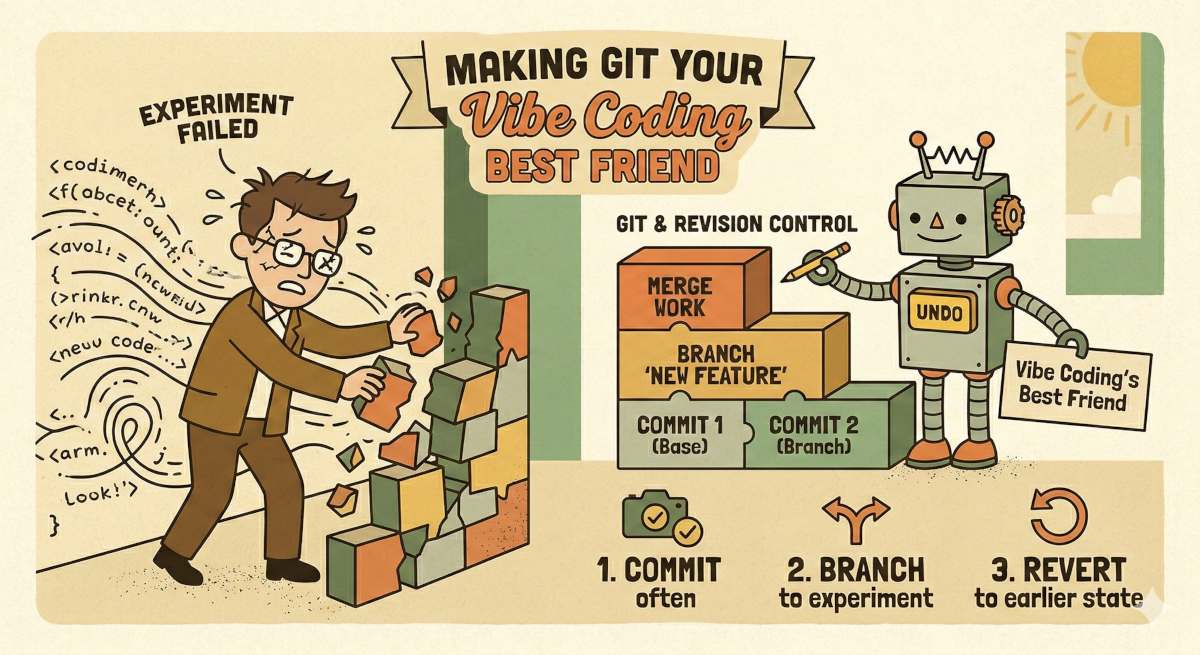
If you are just getting started with “vibe coding”, you will eventually hit a wall where your project breaks and you can’t find your way back to a working version.
Git is the load-bearing pillar for any scalable coding project, providing a robust revision control system that allows you to track changes, experiment without risk, and revert to previous versions of your code, documents, or digital assets.
What is Git and Why Does Your “Vibe” Need It?
Before we dive into the workflow, let’s establish some clarity on the terminology.
Git is an open-source, distributed version control system (VCS). Think of it as a professional-grade “Undo” button and a historical archive for every single line of code you write. While vibe coding makes the initial creation feel like magic, Git provides the pragmatic framework to ensure that magic doesn’t vanish when a prompt goes sideways.
The Blueprint of Version Control
In my experience building Solar Forecast Dashboard, I’ve found that I treated AI-generated code like a sandcastle—beautiful until the tide comes in.
Git transforms your code into a permanent structure.
- Version History: Every “save” (called a commit) is a snapshot in time.
- Branching: You can create a “branch” to test a new feature without affecting your main, working application.
- Peace of Mind: If your AI assistant generates a “hallucination” that breaks your app, you can revert to the previous state in seconds.
Local Development to Collaboration: Git vs. GitHub
When I was building small JavaScript apps, I thought I could skip the technical overhead of version control.
However, as my systems grew in complexity, the need for a central repository became undeniable.
| Feature | Git (The Engine) | GitHub (The Garage) |
|---|---|---|
| What is it? | A local software tool for version control. | A cloud-based hosting service for Git repositories. |
| Primary Use | Tracking changes on your personal machine. | Sharing code, collaborating with teams, and backing up work. |
| Connectivity | Operates entirely offline | Requires an internet connection to “push” or “pull” data. |
If you are working across multiple devices or want to share your “vibe” with the world, GitHub is the industry-standard platform to host your code.
According to recent developer surveys, GitHub remains the most popular platform for open-source and private collaboration, hosting over 100 million developers.
How to Integrate Git into Your Vibe Coding Workflow
We have tested this integration across various AI-driven IDEs (Integrated Development Environments). To build a scalable content or code engine, follow these steps:
- Initialize Your Repository: Run
git initin your project folder to start tracking. - Commit Often: After every successful “vibe” or prompt result that works, commit your changes with a descriptive message like
git commit -m "added navigation bar". - Use Branches for Experiments: If you’re asking an AI to do something risky, create a new branch first using
git checkout -b experiment-feature. - Sync to GitHub: Connect your local folder to a GitHub repository to ensure your work is backed up and accessible from anywhere.
Frequently Asked Questions
Is Git hard to learn for non-coders?
No. While Git has a reputation for complexity, you only need to master 4 or 5 basic commands to gain 90% of its benefits. It is a system for organization, not just a tool for experts.
Does Git work for things other than code?
Yes. Git is excellent for tracking changes in any text-based format, including Markdown files, books, and even complex prompt engineering libraries.
Is GitHub free?
GitHub offers a very generous free tier for individuals, including unlimited public and private repositories.